If you’ve ever stood next to a high-speed yarn winding machine, watching a perfect cone take shape only to have it unravel, snag, or deform half an hour later, you know how frustrating yarn tension issues can be. As a yarn winding machine supplier with over 15 years of on-site support work, I’ve seen every possible tension-related problem—from micro-snags that turn into fabric defects weeks down the line to full cone collapses that halt an entire production shift. Today, I’m walking you through the systematic troubleshooting process I teach our customers, straight from the field, no jargon-heavy fluff you’d find in a generic manual. Yarn Winding Machine
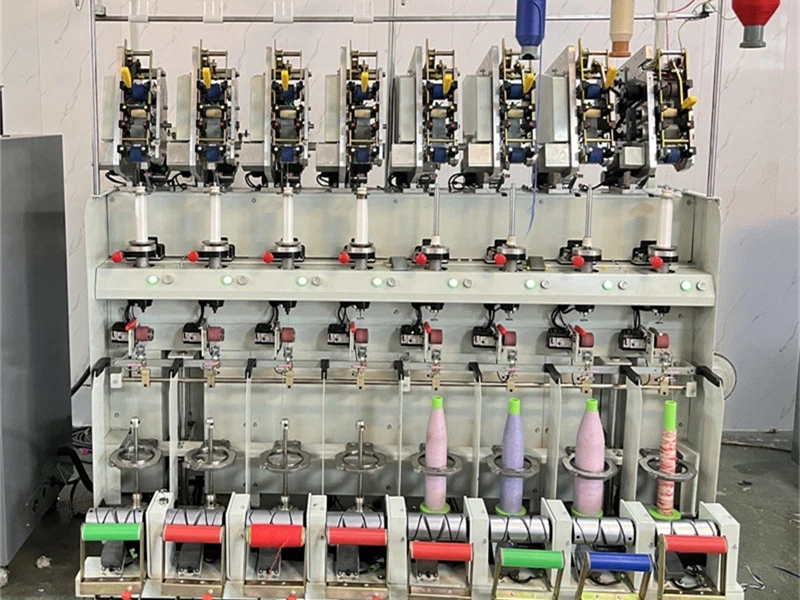
First, let’s get one thing straight: yarn tension isn’t a single, fixed number. It’s a dynamic balance. Too tight, and the yarn stretches permanently, losing elasticity and leading to breakage downstream. Too loose, and the cone builds unevenly, with soft spots that collapse during unwinding. The sweet spot? It varies by yarn type—cotton vs. polyester vs. wool all need different tension ranges, and even the same yarn behaves differently depending on its count and twist. I once worked with a textile mill in North Carolina that was winding 40s cotton and kept seeing 15% higher breakage rates than industry averages. Turns out, their machine’s default tension setting was calibrated for 30s cotton, a tiny mismatch that snowballed into major downtime.
Let’s start with the most common, easiest-to-fix issues, because 80% of tension problems aren’t caused by broken parts—they’re from simple wear or setup missteps. I always tell new operators to do a quick “yarn path check” before diving into deep diagnostics. Start at the creel, where the yarn is fed from the original package. Even a small notch on a creel guide can catch the yarn and cause a temporary tension spike every time it passes that spot. Last year, a customer in Bangladesh called me panicking because their cones had random thick spots. When I showed up, I ran my finger along the yarn path and felt a tiny burr on a ceramic guide that had chipped during a routine cleaning. We swapped the guide and fixed the issue in 10 minutes.
Next, check the tensioner itself. Most modern winding machines use either mechanical disc tensioners or magnetic tensioners, and both need regular maintenance. For mechanical disc tensioners, the number one culprit is accumulated lint and yarn residue between the discs. Over time, this debris acts like extra tension, pulling the yarn too tight. I recommend operators take apart tensioners every two weeks, wipe the discs with isopropyl alcohol, and make sure the spring that creates pressure isn’t worn out. If the spring is sagging, it can’t maintain consistent pressure, leading to uneven tension. For magnetic tensioners, which are more common for high-speed production, check the magnetic gap. If it’s misaligned or covered in dust, the magnetic force fluctuates, causing tension spikes. We had a customer in Portugal learn this the hard way—they skipped cleaning their magnetic tensioners for three months, and their tension variation hit 25%, leading to 12 hours of unplanned downtime.
Once you’ve ruled out the path and tensioner, move on to the yarn feed and take-up systems. Tension issues often start with how the yarn is fed from the parent package. If the parent package on the creel is wound too tight, it can create back tension that affects the winding process. I always tell customers to inspect their feed packages: if they have hard edges or are misshapen, replace them before starting a run. Also, check the yarn’s unwinding angle. If the yarn is pulled at an extreme angle off the parent package, that creates extra friction and tension. Most machines have a guide that adjusts the angle automatically, but sometimes it gets knocked out of place during package changes—simple adjustment, big difference.
The take-up side is equally important. The cone builder, the part that wraps the yarn into the final shape, uses pressure rollers to keep the cone uniform. If the pressure roller is worn, dirty, or misadjusted, it can compress some parts of the cone and leave others loose, leading to uneven tension across the cone. Last month, a customer in Vietnam called saying their cones were winding lopsided and breaking constantly. When I checked, the take-up roller had a flat spot from years of use. We replaced it and adjusted the cone winding tension, and their breakage rate dropped immediately. Also, check the spindle speed: if the spindle is vibrating, that will make the tension fluctuate. Vibrations can come from worn bearings, an unbalanced spindle, or even the floor of the production building. I once had a customer in India whose entire factory was built on a shallow foundation; they had to reinforce the floor under their winding machines to fix vibration-related tension issues.
Now, if you’ve checked all these parts and are still seeing tension problems, it’s time to look at machine calibration. Most modern winding machines have electronic tension monitoring systems, which track tension in real time and alert operators to spikes or drops. But even these systems need to be calibrated regularly. Calibration is simple: run a test with a known tension yarn (we supply these as part of our machine setup kits) and adjust the monitor’s reading to match the actual tension. I’ve seen operators skip calibration, leading the machine’s readout to be off by 20%—they think tension is set correctly, but it’s actually too high or low. Also, check the machine’s programming: some newer machines let you set different tension zones for different parts of the cone (base, middle, top). If the programming gets corrupted, that will lead to uneven tension across the cone, causing unwinding issues later. We had a customer in Mexico update their machine’s firmware and forget to re-set the tension zone parameters, leading to soft cone tops that collapsed during unwinding for a week until they called us for help.
Wait, let’s not forget environmental factors. Tension is affected by humidity and temperature, and I’ve seen this cause issues in surprisingly many climates. In dry, arid regions, yarn gets brittle, leading to higher tension and more breakage. In humid regions, yarn absorbs moisture, making it stretchier and leading to looser tension, which causes uneven cone winding. A customer in Saudi Arabia called me two years ago saying their cotton yarn was breaking constantly during summer months, when humidity dropped to 20%. We recommended adding a small humidifier near the winding machines and adjusting the tension settings by 10% for dry conditions, and that fixed the problem. For high-humidity areas like Southeast Asia, we suggest adding dehumidifiers to the production floor and adjusting tension to account for the yarn’s extra stretch.
Now, let’s walk through a quick, step-by-step troubleshooting checklist you can use the next time you have tension issues: 1. Do a full yarn path inspection for notches, burrs, or debris on guides. 2. Clean and inspect tensioners (disc or magnetic) for wear or buildup. 3. Check parent package condition and unwinding angle. 4. Inspect take-up rollers and spindle for vibration or wear. 5. Calibrate electronic tension monitors and verify programming. 6. Check environmental conditions and adjust settings accordingly.
The key takeaway here is that yarn tension issues are almost always a symptom of another problem—not a failure of the machine itself. Over my years as a winding machine supplier, I’ve helped customers fix tension issues with nothing more than a cleaning, a guide swap, or a quick adjustment. But when those simple fixes don’t work, you need a partner who knows these machines inside and out.

If you’re tired of unplanned downtime from tension-related issues, if you want to make sure your winding process is running at peak efficiency, and if you’re looking for a reliable winding machine supplier that doesn’t just sell equipment but supports you through every step, reach out to our team. We offer on-site troubleshooting, routine maintenance kits, and custom calibration for every yarn type you work with. Whether you’re a small mill just starting out or a large production facility dealing with 24/7 runs, we have the expertise to help you fix tension issues and keep your production moving smoothly.
Yarn Winding Machine Reference
Textile Institute. (2019). Yarn Processing: Principles and Practice. Woodhead Publishing.
Lawrence, C. A. (2003). Fundamentals of Spinning Technology. The Textile Institute.
Winding Machine Maintenance Manual. (2022). Custom Equipment Solutions Inc.
Zhangjiagang Kingkangda Machinery Co., Ltd.
Zhangjiagang Kingkangda Machinery Co., Ltd. is one of the most professional yarn winding machine manufacturers and suppliers in China, specialized in providing high quality customized service. We warmly welcome you to wholesale yarn winding machine in stock here from our factory. Contact us for pricelist and quotation.
Address: Korea Industrial Park, Fenghuang Town, Zhangjiagang City, Jiangsu Province, China
E-mail: kingkangdacn@hotmail.com
WebSite: https://www.kingkangda.com/
